Do you have multiple sales channels and manage accounting in Tripletex? Let Omnium take care of the integrations and automate the entire process from the customer finding your products to the order being shipped and the invoice being recorded.
Tripletex is a cloud-based finance and accounting system. Through Omnium's integration, we ensure the creation of products, customers, orders, payments, and invoices directly in Tripletex.
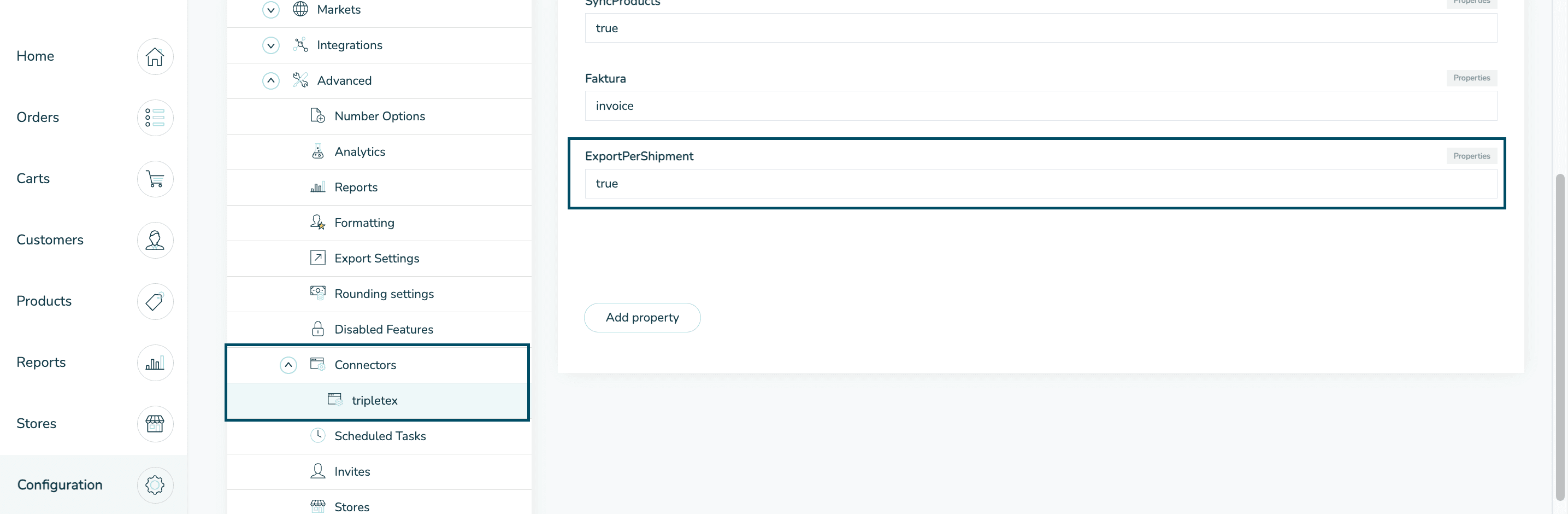
Post orders to Tripletex per partial shipment instead of per order.
{ "key": "ExportPerShipment", "value": "true"}
Effect:
One order is created in Tripletex per shipment.
Orders can be posted even if only one of the shipments has been completed.
If your orders include split shipments (multiple shipments per order), it is recommended to enable this setting to ensure correct posting in Tripletex.
Add the property "SyncProducts": "true" to the Tripletex connector options.
Set the property "TripletexProductAccount": "<accountNumber>" on the category you wish to book on a specific account.
Set up the scheduled task Update product categories. This task copies the category information onto the products in Omnium, enriching them with the property from step 2.
Changes made to categories will not take effect until the scheduled task has run. You can manually trigger it from the scheduled task list under Configuration → Settings in Omnium.
When exporting invoices or orders to Tripletex, the connector looks up the product for each order line and checks for the "TripletexProductAccount" property. If present, the product in Tripletex will have its account updated to the specified account.
Every Tripletex order line must be tagged with a Tripletex VAT type — the numeric id of a row in Tripletex's ledger/vatType register. When Omnium exports an order, shipment, or return, the connector resolves a VAT type for each line by combining several inputs: the connector default, the market default, the tax rate on the order line itself, optional per-category overrides, and finally the destination address. This section explains the full resolution chain, when each layer kicks in, and how to extend it.
The Norwegian Tripletex VAT register includes (among many others) the following IDs that the connector treats specially:
Id
Description
3
Outbound tax, high rate (25%)
5
Outbound tax, zero rate — goods with deduction right (e.g. books)
6
No output tax (outside the VAT Act) (0%)
31
Outbound tax, medium rate (15%) — e.g. groceries
52
Duty-free export of goods and services (0%) — used for Svalbard/Jan Mayen
The full list of available VAT types — including any custom types — can be retrieved from Tripletex via GET /v2/ledger/vatType. Note that IDs can differ between tenants for custom types, so always verify against the live register.
For each order line the connector applies the following layers, in this order. A later layer overrides an earlier one.
Connector default — the connector starts from VAT type id = 3 (high rate, 25%).
Market default — if the order has a MarketId and the corresponding Omnium market has DefaultVatType set, that VAT type becomes the new default for the order. Use this to switch entire markets to a different VAT regime (e.g. a Swedish market with a Tripletex VAT type for Swedish sales).
Order-line tax rate heuristic — applied per line on top of the default:
If the default is 3 (high rate) and the order line has TaxRate == 0, the line is exported as id = 6 (outside the VAT Act).
If the order line has TaxRate ≈ 15, the line is exported as id = 31 (medium rate).
Otherwise, the default VAT type is used.
Per-category override — if UseCategoryVatTypeOverride is enabled on the connector and the product's category tree resolves to a TripleTexVatTypeId, that VAT type replaces the value picked in steps 1–3 for that line. See VAT-Type Override per Product Category below.
Svalbard / Jan Mayen — if the destination address is on Svalbard or Jan Mayen, every order line on the export is forced to id = 52 (duty-free export), overriding all previous layers. See Svalbard and Jan Mayen below.
The shipping order line ("Frakt") always uses the resolved default VAT type for the order (steps 1–2), not the per-line or per-category logic. Svalbard still applies to the shipping line because the Svalbard override iterates over all lines.
The IsPrioritizeAmountsIncludingVat connector setting (see Connector Settings) controls whether Tripletex treats the including-VAT or excluding-VAT amount as the source of truth when the resolved VAT type implies a different rate than what was on the original order line. With the default true, the gross amount is preserved and Tripletex re-derives the net amount from it; with false, the net amount is preserved and Tripletex re-derives the gross. This setting matters when categories or markets remap a line to a VAT type that doesn't match the rate used at checkout.
Some assortments require a specific Tripletex VAT type regardless of the rate that came in on the order line. The most common case is books in Norway, which must be booked on a zero-rate-with-deduction VAT type (e.g. id = 5) rather than the high-rate default — even though the order may have arrived from the storefront with TaxRate = 0 and would otherwise be mapped to id = 6. This is what the per-category override is designed for.
The override is configured on the product category and applies to every order line whose product belongs to that category (or a child category).
For example, on a "Books" category, set the value to 5 to force every order line containing a book to be exported with VAT type 5 (zero rate with deduction).
The override is read directly from the live product category at export time and does not require the Update product categories scheduled task to have run.
When UseCategoryVatTypeOverride is enabled, the connector resolves a VAT-type override per order line during order, shipment, and return export:
For each order line, the connector loads the matching product from Omnium (by product id or SKU).
It collects all product categories the product belongs to via CategoryIds, filtered to the same language as the product.
It walks the category tree starting from the product's MainCategoryId and follows ParentId upwards. The first category in that chain that has a TripleTexVatTypeId property wins.
If no category in the main-category chain has the property set, the connector falls back to the remaining categories on the product and uses the first match found.
The resolved Tripletex VAT type replaces the VAT type that would otherwise have come out of steps 1–3 in the resolution order.
If TripleTexVatTypeId is not set on any of the product's categories — or if the value does not match a known VAT type returned by Tripletex — the order line falls back to the standard resolution (default VAT type adjusted by the line tax rate).
Because the lookup walks up from MainCategoryId first, you can set a broad default TripleTexVatTypeId on a parent category and override it on a more specific child category if needed. The most specific category in the chain takes precedence.
Sales to Svalbard and Jan Mayen are outside the Norwegian VAT area and must be booked as duty-free in Tripletex (VAT type id = 52). The connector detects these destinations from the shipping address postal code on the order or shipment being exported:
Postal code
Treated as
917xx (prefix)
Svalbard
8099
Jan Mayen
When the destination matches, the connector overwrites the vatType on every order line in the export — including any per-category override and the shipping line — to VAT type id = 52. This applies to both order exports and return exports.
The detection is purely postal-code based; the country code on the address is not consulted. Norwegian addresses with a postal code outside the ranges above are handled as ordinary Norwegian sales. There is no connector setting to disable this behavior — if a Svalbard address must be exported with a different VAT type, the address itself has to be changed.